

Throughout time, there have been instances of desolation and destruction, but also times of peace and prosperity. The contrasts between the two provide insight and show us patterns we can learn from. My interest in history, survival stories, and the rise and fall of civilizations led me to the idea that brought about this article, Shortages That Lead to Famine. The patterns that lead to famine are woven throughout history and current events worldwide.
Have you noticed a pattern emerging in the news in what is being reported? A common thread I’ve noticed is that we are consuming more than we produce. The government spends more than it brings in; insurance costs are higher than the average family can afford; students rack up more debt than they can reasonably repay, and the list goes on. What is the result of the accumulation of a country’s shortages? I believe the answer is famine. The very definition of famine is “a great shortage”.
Let’s take a look at 10 historical patterns illustrating shortages that lead to famine.
10 Shortages That Lead to Historical Famines
1. A Shortage of Food Imports
Historical example: Germany during World War I (1914–1918)
Britain’s naval blockade cut Germany off from imported grain, fertilizer, and animal feed. Even though food still existed globally, Germany could not access it. Domestic production fell sharply, leading to the “Turnip Winter” of 1916–1917, when millions survived on animal feed. Starvation followed—not because food didn’t exist, but because imports were blocked.
2. A Shortage of Government Resources to Help Citizens
Historical example: Ireland during the Great Famine (1845–1852)
The British government lacked both the will and financial commitment to adequately intervene. Relief programs were inconsistent, underfunded, and short-lived. While food was exported out of Ireland, the government failed to sustain aid, allowing mass starvation to occur.
3. A Shortage of Community Resources
Historical example: Soviet Union during the Holodomor (1932–1933)
Local aid networks collapsed as food was confiscated by the state. Communities were stripped of the ability to help one another—churches, mutual aid, and local food sharing were criminalized. Once community-level support disappeared, starvation accelerated rapidly.
4. A Shortage of Growing Seasons (Weather Disruption)
Historical example: The Sahel Famine in Africa (1970s–1980s)
Years of drought across the Sahel region shortened growing seasons and devastated crops. Repeated weather failures meant farmers couldn’t recover year to year. Livestock died, soil degraded, and food insecurity turned into famine after multiple failed seasons.
5. A Shortage of Vitamin-Rich Food
Historical example: Potato-dependent populations in 19th-century Europe
When potatoes failed, people survived briefly on grain—but suffered from vitamin deficiencies, leading to scurvy, weakened immunity, and high mortality even when calories were present.
Historical example: European populations during medieval famines
When crops failed and diets narrowed to grains alone, vitamin deficiencies surged. Lack of sunlight and crop diversity led to scurvy, weakened immunity, and increased disease. People didn’t just starve—they succumbed to illness made worse by malnutrition.
6. A Shortage of Meat and Dairy
Historical example: China’s Great Famine (1959–1961)
Livestock populations collapsed due to poor feed, over-slaughtering, and agricultural mismanagement. Meat and dairy disappeared from diets. Without protein and fat, mortality rose sharply—especially among children and the elderly.
7. A Shortage of Healthy Immune Systems
Historical example: Bengal Famine (1943)
Malnutrition weakened immune systems, allowing diseases like cholera, malaria, and dysentery to spread rapidly. Many victims died not directly from starvation, but from illness their bodies could no longer fight. Famine and disease fed each other in a deadly cycle.
8. A Shortage of Peace (Conflict Over Food)
Historical example: Yemen (ongoing crisis)
Civil war disrupted food production, transport, and aid delivery. Food became a weapon of war. Markets collapsed, prices soared, and civilians were trapped between conflict and hunger. Food existed in the world, but violence made it inaccessible. Hunger became a weapon.
9. A Shortage of Harvests (Extended Scarcity)
Historical example: Joseph’s Egypt (Biblical account, Genesis 41)
Seven years of abundance were followed by seven years of famine. Neighboring regions without stored reserves collapsed first. Egypt survived because it recognized that famine is often prolonged—not a single bad year, but repeated shortages without recovery time.
10. A Shortage of Skilled Labor
Historical example: Post–Black Death Europe (14th century)
As disease and famine killed large portions of the population, skilled farmers, millers, and transport workers disappeared. Fields went unplanted, harvests rotted, and food systems broke down—not from lack of land, but lack of people who knew how to work it.
In a wealthy, agriculturally powerful nation like the United States of America, early stages of the same breakdowns that have historically preceded famines are starting to appear.
What Shortages Are Happening in the U.S.?Shortages that Lead to Famine
1. Shortage of Food Imports
The U.S. still produces most of its own staple grains, but there are increasing concerns about dependency on imports for certain fruits, vegetables, and specialty crops, especially produce from Mexico and Canada. Some analysts suggest this reduces resilience if disrupted by trade policy or climate shocks.
Warning sign: Greater reliance on imported produce could make the food supply more sensitive to geopolitical shocks.
2. Shortage of Government Resources to Help Citizens
Recent political gridlock — such as federal government shutdowns in late 2025 — threatened SNAP and WIC benefits, straining food assistance networks.
Warning sign: Interruptions in federal food aid and social support systems make vulnerable populations more exposed to insecurity.
3. Shortage of Community Resources
Food banks and food pantries are facing rising demand. Increases in food insecurity are outpacing previous years’ needs, and the USDA plans to stop publishing detailed hunger tracking, limiting visibility.
Warning sign: If community-level support erodes while demand grows, localized shortages can deepen.
4. Shortage of Growing Seasons (Weather Disruption)
Climate change is disrupting weather patterns that affect farming — droughts, heat waves, and extreme events can reduce yield quality and quantity. The CDC highlights climate’s impact on food production and distribution.
Warning sign: More frequent severe weather events could impair consistent crop production.
5. Shortage of Vitamin-Rich Food
As prices rise, families often shift toward shelf-stable, ultra-processed foods that meet calorie needs but lack micronutrients. Inflation is narrowing diets for some families, forcing reliance on cheaper, less nutritious foods, especially among food-insecure households.
Warning sign: Nutritional quality (not just quantity) matters for health and long-term immunity.
6. Shortage of Meat & Dairy
Meat and dairy supply chains are sensitive to labor shortages, feed costs, and processing bottlenecks. While not catastrophic, market pressures can reduce availability or increase prices — particularly for lower-income households.
Warning sign: High prices and labor constraints in meat/dairy production can translate into localized shortages.
7. Shortage of Healthy Immune Systems
The pandemic showed how health crises can intersect with food access. A nutritionally insecure population tends to have weaker immune outcomes, which was evident when COVID-19 hit vulnerable communities hardest.
Warning sign: Health and nutrition are deeply intertwined — poor diets make populations more vulnerable to disease.
8. Shortage of Peace (Social Stability Related to Food Stress)
The U.S. remains highly stable politically, and there are no widespread food riots. However, localized unrest or protests around living costs have occurred, often tied to inflation and scarcity of essentials like groceries.
Warning sign: Sharp price increases for food essentials can contribute to public frustration.
9. Shortage of Harvests (Prolonged Scarcity)
The U.S. has not faced multi-year crop failures, but climate variability, droughts in key regions like the Southwest, and water shortages (e.g., Colorado River issues) are threats to multi-year productivity. This is a broad systemic risk, not present as a famine trigger now.
10. Shortage of Skilled Labor
Labor shortages in agriculture are a real concern, especially where immigration policy and workforce constraints limit farm labor availability. This can lead to crops going unharvested or higher production costs.
Warning sign: Without enough skilled and seasonal labor, agricultural systems can become fragile.
Shortages Happening in the U.S.
Here’s how the U.S. stacks up against your 10 categories:
✅ Present warning signs (some mild, some significant):
-
Increased food insecurity and reliance on food banks
-
Government resource vulnerabilities (e.g., SNAP disruptions)
-
Climate/weather pressures on food production
-
Labor shortages in agriculture
-
Tariffs affecting imports
-
Nutritional access inequality
The United States is not currently in famine, but watch for signs of shortages. These are early stress signals. These aren’t famine triggers, but they are vulnerabilities that, if left unaddressed, could make our food system fragile.
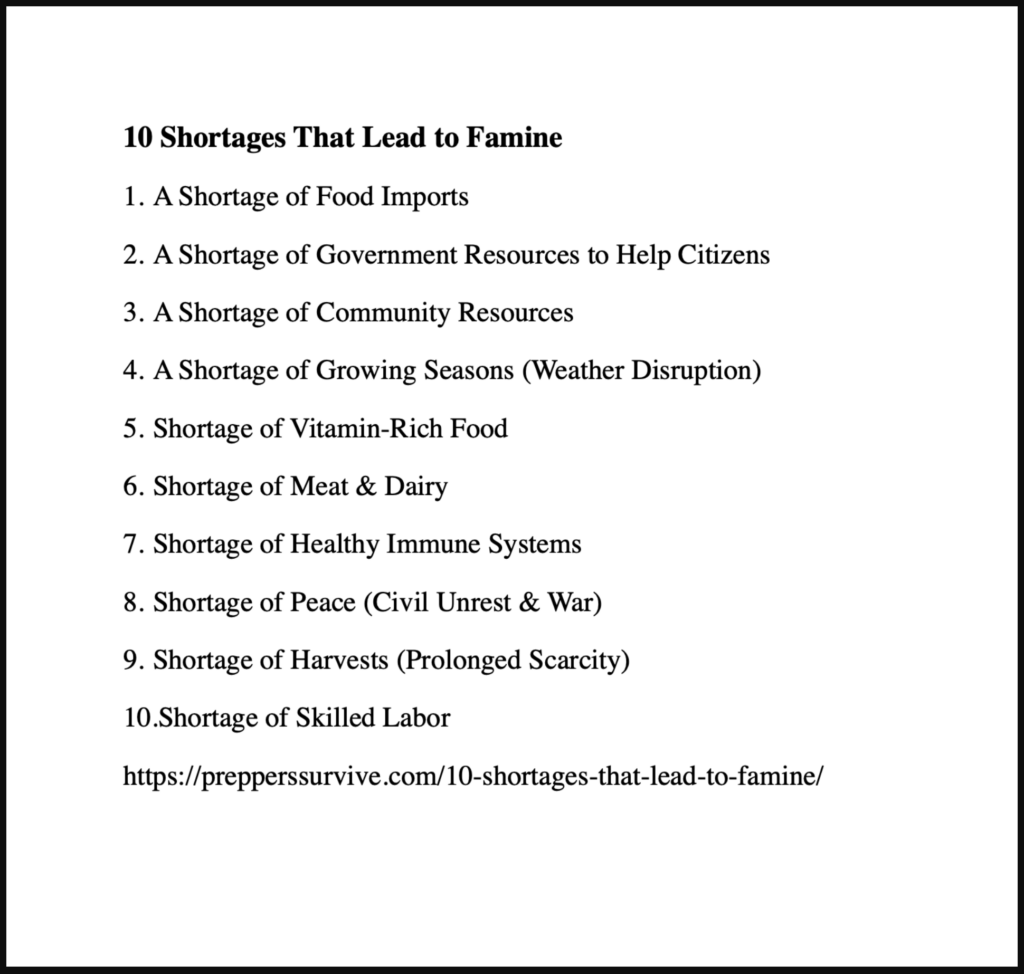
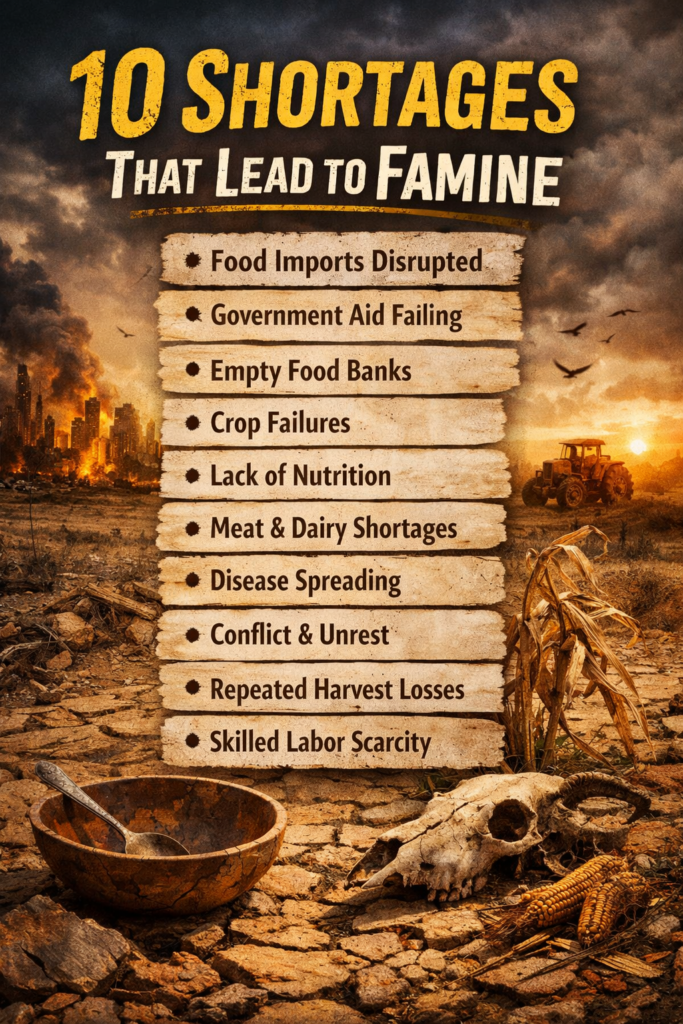
When shortages stack up, systems start failing, which primes us for famine. History shows it has happened more than once. Below is a list you can print. Pick a book from the list below and see how many shortage you spot when a country faces famine. We can learn a lot by rediscovering how others survived.
📄 Printable List – 10 Shortages That Lead to Famine
Interesting Reads:

Widely considered the most documented famine of the 19th century, this catastrophe was fueled by potato blight and British colonial policy.


The Starvation Blockades by Nigel Hawkins: Describes the strategic use of food as a weapon and its impact on the German civilian population.


Thanks for visiting Preppers Survive. Before you leave subscribe to our newsletter. If you enjoyed this article on Shortages that Lead to Famine, please share it on your favorite social media.

Leave a Reply